Rapid City, SD Hail Storm – July 2025
July 1, 2025 hail storm near Rapid City, SD. Radar-confirmed hail track and contractor lead lists available.
Max Hail
4"2" est.
confirmed
Zones
22
NWS alerts
Radar
995
dual-pol hits
Spotter
25
field reports
NWS WARNING AREA · Rapid City Metro · Jul 1, 2025
Intelligence Platform
StormSnipe Pro
$49/ mo
Cancel anytime · No contracts
›All 50 states
›No zone limits
›No per-event fees
Subscribe to Pro
Pro renews monthly until canceled · Cancel anytime in the billing portal
What's included
Instant delivery
Every storm published within hours of NOAA confirmation.
Interactive Strike Map
Full radar-confirmed hail track on an interactive map.
Address CSV export
Every affected residential address, export-ready.
Smart alerts
Notified when a storm hits your area. Set zones once.
Nationwide coverage
All 50 states. No zone restrictions. No geographic caps.
Live pipeline
NOAA NEXRAD processed and delivered 24/7.
Address data notice
Pro coverage in California, Vermont, and Oregon includes the confirmed hail track and Strike Map only — no address lists. State data-privacy law treats compiled address lists differently in those three states, so we exclude their addresses from extraction and delivery.
NWS WARNING AREAS · 22
This storm generated 22 NWS alert zones. Pro access covers the complete storm track and all addresses across every zone.
ZONE 1NWS UNR
Rapid City, SD
Spotter Reported
Alert issued Tue, Jul 1 · 9:32 PM UTC
0.75"
confirmed
1.75"
est. (NWS)
ZONE 2NWS UNR
Rapid City, SD
Spotter Reported
Alert issued Tue, Jul 1 · 9:55 PM UTC
1"
confirmed
1.5"
est. (NWS)
ZONE 3NWS UNR
Hermosa, SD
Spotter Reported
Alert issued Tue, Jul 1 · 10:23 PM UTC
1"
confirmed
1.75"
est. (NWS)
ZONE 4NWS UNR
Fairburn, SD
Dual-Pol Radar
Alert issued Tue, Jul 1 · 11:13 PM UTC
1"
confirmed
1.75"
est. (NWS)
ZONE 5NWS UNR
Philip, SD
Dual-Pol Radar
Alert issued Tue, Jul 1 · 11:19 PM UTC
2.25"
confirmed
1.75"
est. (NWS)
ZONE 6NWS UNR
Kadoka, SD
Dual-Pol Radar
Alert issued Tue, Jul 1 · 11:43 PM UTC
1.75"
confirmed
1.5"
est. (NWS)
ZONE 7NWS ABR
Murdo, SD
Dual-Pol Radar
Alert issued Wed, Jul 2 · 12:01 AM UTC
2.25"
confirmed
1"
est. (NWS)
ZONE 8NWS CYS
Alliance, NE
Dual-Pol Radar
33 addresses in warning area
Alert issued Wed, Jul 2 · 12:05 AM UTC
1.75"
confirmed
1"
est. (NWS)
ZONE 9NWS UNR
White River, SD
Dual-Pol Radar
Alert issued Wed, Jul 2 · 12:13 AM UTC
3"
confirmed
1.5"
est. (NWS)
ZONE 10NWS UNR
Oelrichs, SD
Dual-Pol Radar
Alert issued Wed, Jul 2 · 12:33 AM UTC
4"
confirmed
1.75"
est. (NWS)
ZONE 11NWS UNR
Kyle, SD
Dual-Pol Radar
48 addresses in warning area
Alert issued Wed, Jul 2 · 12:43 AM UTC
2.5"
confirmed
1.5"
est. (NWS)
ZONE 12NWS UNR
White River, SD
Dual-Pol Radar
1,313 addresses in warning area
Alert issued Wed, Jul 2 · 12:46 AM UTC
2.5"
confirmed
1.5"
est. (NWS)
ZONE 13NWS CYS
Chadron, NE
Dual-Pol Radar
1 addresses in warning area
Alert issued Wed, Jul 2 · 12:46 AM UTC
1"
confirmed
1.75"
est. (NWS)
ZONE 14NWS LBF
Gordon, NE
Dual-Pol Radar
Alert issued Wed, Jul 2 · 12:49 AM UTC
2.5"
confirmed
2"
est. (NWS)
ZONE 15NWS LBF
Lakeside, NE
Dual-Pol Radar
64 addresses in warning area
Alert issued Wed, Jul 2 · 12:52 AM UTC
2.5"
confirmed
2"
est. (NWS)
ZONE 16NWS LBF
Gordon, NE
Dual-Pol Radar
101 addresses in warning area
Alert issued Wed, Jul 2 · 1:25 AM UTC
2.5"
confirmed
1.25"
est. (NWS)
ZONE 17NWS LBF
Lakeside, NE
Dual-Pol Radar
Alert issued Wed, Jul 2 · 1:28 AM UTC
2.5"
confirmed
2"
est. (NWS)
ZONE 18NWS UNR
Rosebud, SD
Dual-Pol Radar
Alert issued Wed, Jul 2 · 1:39 AM UTC
2.5"
confirmed
1.25"
est. (NWS)
ZONE 19NWS UNR
Mission, SD
Dual-Pol Radar
280 addresses in warning area
Alert issued Wed, Jul 2 · 2:09 AM UTC
2.5"
confirmed
1.25"
est. (NWS)
ZONE 20NWS LBF
Nenzel, NE
Dual-Pol Radar
128 addresses in warning area
Alert issued Wed, Jul 2 · 3:04 AM UTC
2.5"
confirmed
1.5"
est. (NWS)
ZONE 21NWS LBF
Mullen, NE
Dual-Pol Radar
57 addresses in warning area
Alert issued Wed, Jul 2 · 3:20 AM UTC
1.75"
confirmed
1"
est. (NWS)
ZONE 22NWS LBF
Burwell, NE
Dual-Pol Radar
992 addresses in warning area
Alert issued Wed, Jul 2 · 3:54 AM UTC
2.25"
confirmed
1.5"
est. (NWS)
What Happened
A severe hail storm crossed the Rapid City, SD metro on July 1, 2025, with peak hail reports of 1.75 inches and multiple spotter-confirmed hail observations through the late afternoon and evening. The event concluded after a long sequence of warnings, radar detections, and ground reports across the metro area.
The first high-end radar-derived hail alert came at 4:32 PM CDT with 1.75-inch hail confidence. Another 1.5-inch alert followed at 4:55 PM CDT, then a second 1.75-inch alert at 5:23 PM CDT. Spotters reported nickel to quarter size hail at 5:27 PM CDT, with two separate reports at the same time placing the hail near 1 inch. A later spotter report at 7:02 PM CDT described dime to quarter hail, also around 1 inch.
Radar and field confidence stayed elevated into the evening. Alerts at 6:13 PM CDT and 6:19 PM CDT again reached 1.75 inches with radar and spotter verification. Additional 1.5-inch alerts were issued at 6:43 PM CDT, 7:13 PM CDT, 7:43 PM CDT, and 7:46 PM CDT. A later 1.75-inch radar alert came at 7:33 PM CDT. The final two alerts, at 8:39 PM CDT and 9:09 PM CDT, showed 1.25-inch hail confidence as the storm weakened.
The storm produced a broad warning area across the Rapid City metro, with hail reports clustering through the middle and later portions of the event. The repeated radar signals and spotter observations pointed to a storm that maintained hail production across several hours rather than a brief pulse.
Damage Assessment
The field reports show a storm that reached the ground with enough intensity to support spotter-confirmed hail near 1 inch in multiple locations. Nickel to quarter size hail was reported twice at 5:27 PM CDT, and dime to quarter hail was reported again at 7:02 PM CDT. Those reports place the heaviest surface impact in the quarter-size range for the observed ground truth.
The radar alerts were stronger than the spotter hail size in some intervals, which is common in a storm with changing hail cores. The 1.75-inch radar confidence at 4:32 PM CDT, 5:23 PM CDT, 6:13 PM CDT, 6:19 PM CDT, and 7:33 PM CDT shows a storm capable of producing larger stones aloft even where field reports documented smaller hail at the surface. The later 1.25-inch alerts at 8:39 PM CDT and 9:09 PM CDT show the storm easing down while still carrying hail potential.
For surface impact, the reports point to repeated hail fall across the metro rather than a single isolated strike point. That pattern matters for roof, siding, gutter, and vehicle checks across exposed properties in the warning area, especially where hail fell in more than one round. A contractor should expect scattered but widespread cosmetic claims, with the most visible issues likely on soft metals, vehicle finishes, and older roof materials that took multiple passes.
What Contractors Should Know
Storm Details
- Start Date
- Tuesday, July 1, 2025
- Last Activity
- Tuesday, July 1, 2025
- Location
- Rapid City, SD
- Warning Areas
- 22
- Dual-Pol Radar
- 995
- Spotter Reports
- 25
Preview Strike Map
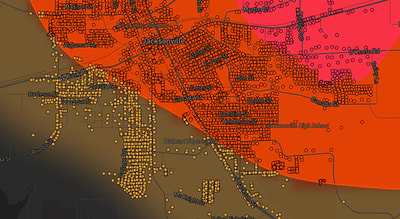
See exactly what you get.
Explore the full Springdale, AR Strike Map free – hail track, address overlay, and CSV download. No account required.
Try the Free Demo →