Guffey, CO Hail Storm – July 2025
July 12, 2025 hail storm near Guffey, CO. Radar-confirmed hail track and contractor lead lists available.
Max Hail
3.5"1.75" est.
confirmed
Zones
7
NWS alerts
Radar
203
dual-pol hits
Spotter
2
field reports
NWS WARNING AREA · Guffey Metro · Jul 12, 2025
Intelligence Platform
StormSnipe Pro
$49/ mo
Cancel anytime · No contracts
›All 50 states
›No zone limits
›No per-event fees
Subscribe to Pro
Pro renews monthly until canceled · Cancel anytime in the billing portal
What's included
Instant delivery
Every storm published within hours of NOAA confirmation.
Interactive Strike Map
Full radar-confirmed hail track on an interactive map.
Address CSV export
Every affected residential address, export-ready.
Smart alerts
Notified when a storm hits your area. Set zones once.
Nationwide coverage
All 50 states. No zone restrictions. No geographic caps.
Live pipeline
NOAA NEXRAD processed and delivered 24/7.
Address data notice
Pro coverage in California, Vermont, and Oregon includes the confirmed hail track and Strike Map only — no address lists. State data-privacy law treats compiled address lists differently in those three states, so we exclude their addresses from extraction and delivery.
NWS WARNING AREAS · 7
This storm generated 7 NWS alert zones. Pro access covers the complete storm track and all addresses across every zone.
ZONE 1NWS BOU
Guffey, CO
Dual-Pol Radar
871 addresses in warning area
Alert issued Sat, Jul 12 · 9:03 PM UTC
2"
confirmed
1"
est. (NWS)
ZONE 2NWS PUB
Florissant, CO
Dual-Pol Radar
807 addresses in warning area
Alert issued Sat, Jul 12 · 9:32 PM UTC
2.25"
confirmed
1"
est. (NWS)
ZONE 3NWS PUB
Weston, CO
Dual-Pol Radar
Alert issued Sat, Jul 12 · 10:31 PM UTC
2.75"
confirmed
1"
est. (NWS)
ZONE 4NWS PUB
Weston, CO
Dual-Pol Radar
119 addresses in warning area
Alert issued Sat, Jul 12 · 10:56 PM UTC
2.75"
confirmed
1"
est. (NWS)
ZONE 5NWS PUB
Walsenburg, CO
Dual-Pol Radar
158 addresses in warning area
Alert issued Sun, Jul 13 · 12:00 AM UTC
3.5"
confirmed
1.75"
est. (NWS)
ZONE 6NWS PUB
Walsenburg, CO
Dual-Pol Radar
Alert issued Sun, Jul 13 · 12:28 AM UTC
3.25"
confirmed
1"
est. (NWS)
ZONE 7NWS PUB
Avondale, CO
Dual-Pol Radar
42 addresses in warning area
Alert issued Sun, Jul 13 · 12:55 AM UTC
3.25"
confirmed
1.5"
est. (NWS)
What Happened
A hail storm moved through Guffey, CO on July 12, 2025, producing hail up to 1.75 inches and multiple severe thunderstorm alerts through late afternoon and early evening. The first verified reports came in around 3:10 PM MDT, when spotters described hail lasting 30 minutes and measured stones at 1.5 inches.
The storm held together for several hours. Two early alerts at 3:03 PM MDT and 3:32 PM MDT carried 1-inch hail estimates with radar and spotter verification. Later alerts at 4:31 PM MDT and 4:56 PM MDT continued to show 1-inch hail potential from dual-polarization radar. By 6:00 PM MDT, radar detections increased to 1.75 inches, followed by additional alerts at 6:28 PM MDT and 6:55 PM MDT with 1-inch and 1.5-inch hail estimates.
The field reports matched the longer-duration nature of the storm. The spotter account from 3:10 PM MDT points to a sustained hail core rather than a brief burst. That report came during the same window as the first alert pair, which placed the most intense activity over the Guffey area during mid-afternoon.
Damage Assessment
The available ground reports point to a hail event with enough duration to raise surface impact beyond a quick pass. A 30-minute hail report in Guffey with 1.5-inch stones suggests repeated strikes on roofs, siding, vehicles, and exposed outdoor equipment. The duplicate spotter-verified report from the same time window reinforces that the hail was observed directly, not inferred only from radar.
The later radar evolution also matters for field crews. The storm did not remain static at a single hail size. It cycled through several warning updates, then reached 1.75-inch estimates by 6:00 PM MDT before easing back to 1-inch and 1.5-inch hail detections later in the evening. That pattern fits a storm that maintained a damaging hail core over the broader Guffey area for an extended period.
For property inspection work, look first at the surfaces that take repeated hail loading. Roofs with soft metals, older three-tab shingles, gutters, downspouts, and vehicle glass can show the clearest marks in an event with this much duration. Outbuildings and ranch structures around Guffey should be checked with the same approach, especially where the report window overlapped with the strongest radar estimates.
Do not assume the strongest hail fell only once. The report set shows separate alert cycles, and the spotter notes describe hail lasting long enough to create layered impact. Crews should expect mixed outcomes across a short drive, especially in rural terrain where one property can show clear bruising while another nearby location has lighter accumulation or fewer visible strikes.
What Contractors Should Know
This event centered on Guffey and the surrounding warning area, with the first ground report arriving at 3:10 PM MDT and the strongest radar estimate reaching 1.75 inches by early evening. Crews working this corridor should prioritize roofs first, then gutters, window screens, soft metals, and parked vehicles. A long hail duration increases the chance of scattered but repeatable impact marks across multiple sides of the same structure.
Storm Details
- Start Date
- Saturday, July 12, 2025
- Last Activity
- Saturday, July 12, 2025
- Location
- Guffey, CO
- Warning Areas
- 7
- Dual-Pol Radar
- 203
- Spotter Reports
- 2
Preview Strike Map
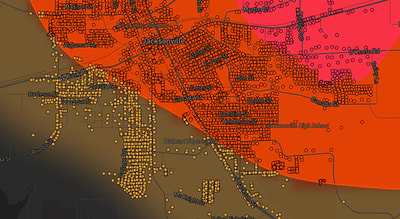
See exactly what you get.
Explore the full Springdale, AR Strike Map free – hail track, address overlay, and CSV download. No account required.
Try the Free Demo →